
Chapter 4 of 8
The Race for Peace (1945–1946)
Jeep Day, the Love Lift, and the Birth of the Farm Jeep
“It is in reality a new and revolutionary type of motor vehicle with no prewar precedent”
Charles Sorensen, Willys news release, June 28,1945
The air at Willys-Overland in early 1945 was thick with a particular kind of urgency. It wasn’t the desperate grinding pace of wartime production — the world already knew the war was won — it was the frantic scramble for what came after. Charles E. Sorensen had arrived in Toledo with a singular objective: make Willys the first manufacturer to release a “peace” vehicle to the public. He had no intention of waiting for a formal surrender in the Pacific.
🔭 The 10,000-Foot View
To understand why Jeep Day mattered, you have to see what the Jeep could—and could not—do in 1945. This is the chapter where the sword becomes the plowshare. Sorensen launches the Jeep as a farm machine before the war ends, exploits a wartime loophole to beat every competitor to market, and stages one of the great press events in automotive history. A year later, the hydraulic lift arrives, and the Farm Jeep is finally whole. But even at its moment of triumph, the men who built it are already starting to go their separate ways.
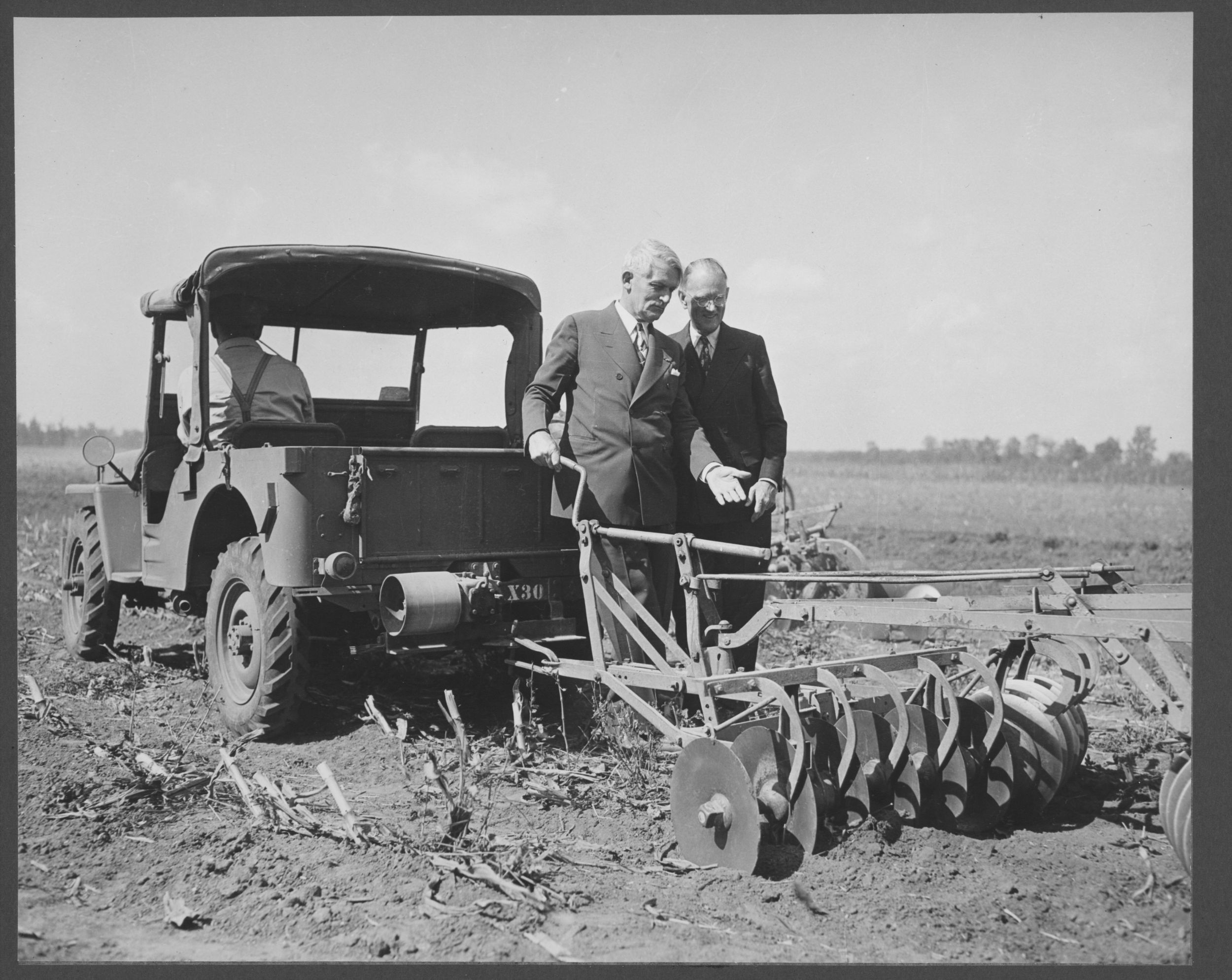
Jeep Day
The civilianization of the Willys Jeep and the resumption of full-scale tractor production were both governed by the War Production Board’s (WPB), shifting priorities toward food security. While most passenger car production was frozen until after V-J Day, Sorensen and Willys-Overland strategically classified the CJ-2A as an “essential” agricultural tool rather than a car. Sorensen had his foot on the accelerator. He wouldn’t have the hydraulic lift, but he didn’t need it to meet the WPB’s requirements for an “essential” agricultural tool. Roos and his engineers had given the Jeep a PTO and a drawbar so it could function as a tractor. Sorensen was ready to issue a media statement heralding the arrival of the “Peace Jeep” and the beginning of the Farm Jeep era.
Sorensen’s confidence, however, was running slightly ahead of his engineers.
Barney Roos’ engineers had worked at a feverish pace since Sorensen’s arrival in the summer of 1944. Fred Coldwell, in his book Preproduction Civilian Jeeps states that the engineering project authorization for the CJ-2A production was given on December 19, 1944. Fred also points out that the “authorization” didn’t mean the Jeep was ready for the production line. There will be more changes made before the July show. Indeed, most of the Jeeps we will see demonstrated on Sorensen’s farm are the “AgriJeep” CJ-1s and CJ-2s, not the CJ-2A.
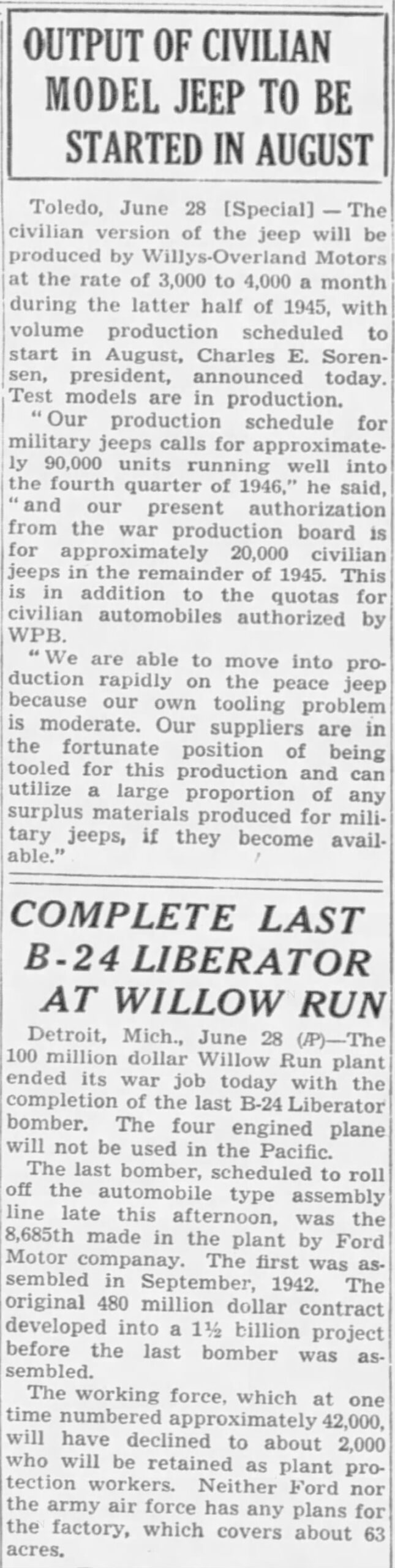
In an ironic twist, the June 29, 1945, financial page of the Chicago Tribune carried two short items, one stacked above the other. There was the story of Sorensen’s announcement that production of the civilian jeep would start soon. Below it was the story of the end of what was Sorensen’s greatest achievement. The last B-24 had rolled off the line at Willow Run.
The sword has been reshaped into the plowshare form, even if incomplete. VE Day has passed, and Sorensen is willing to gamble that enough has been accomplished to make the big announcements. The “Peace Jeep” has arrived. Japan would surrender on August 15. Sorensen has won the race.
Let the Show Begin!
Bil Norris, writing in the Summer 2020 issue of The Dispatcher magazine, tells the story of “‘Jeep’ Day.” He notes that while the 700 invited guests might have expected a gala event in Toledo, the real show was staged at Sorensen’s CESOR farms in New Hudson, MI, about 70 miles north of Toledo. This was a major event in automotive and agricultural history.
Willys ran a two-day press blitz: July 17th at Sorensen’s Michigan farm, where journalists watched “Peace Jeep” prototypes plow and harrow, and July 18th at the Toledo plant, where the first production CJ-2A rolled off the line. One event for the farmer, one for the factory — two news cycles by design. Life magazine dedicated a prominent spread to the event; agricultural journals like Country Gentleman provided technical validation of the PTO; newsreels in movie theaters gave the public their first glimpse of a “peaceful” Jeep. The coverage was immediate, national, and total. By the time Japan surrendered weeks later, the rebranding was already complete.
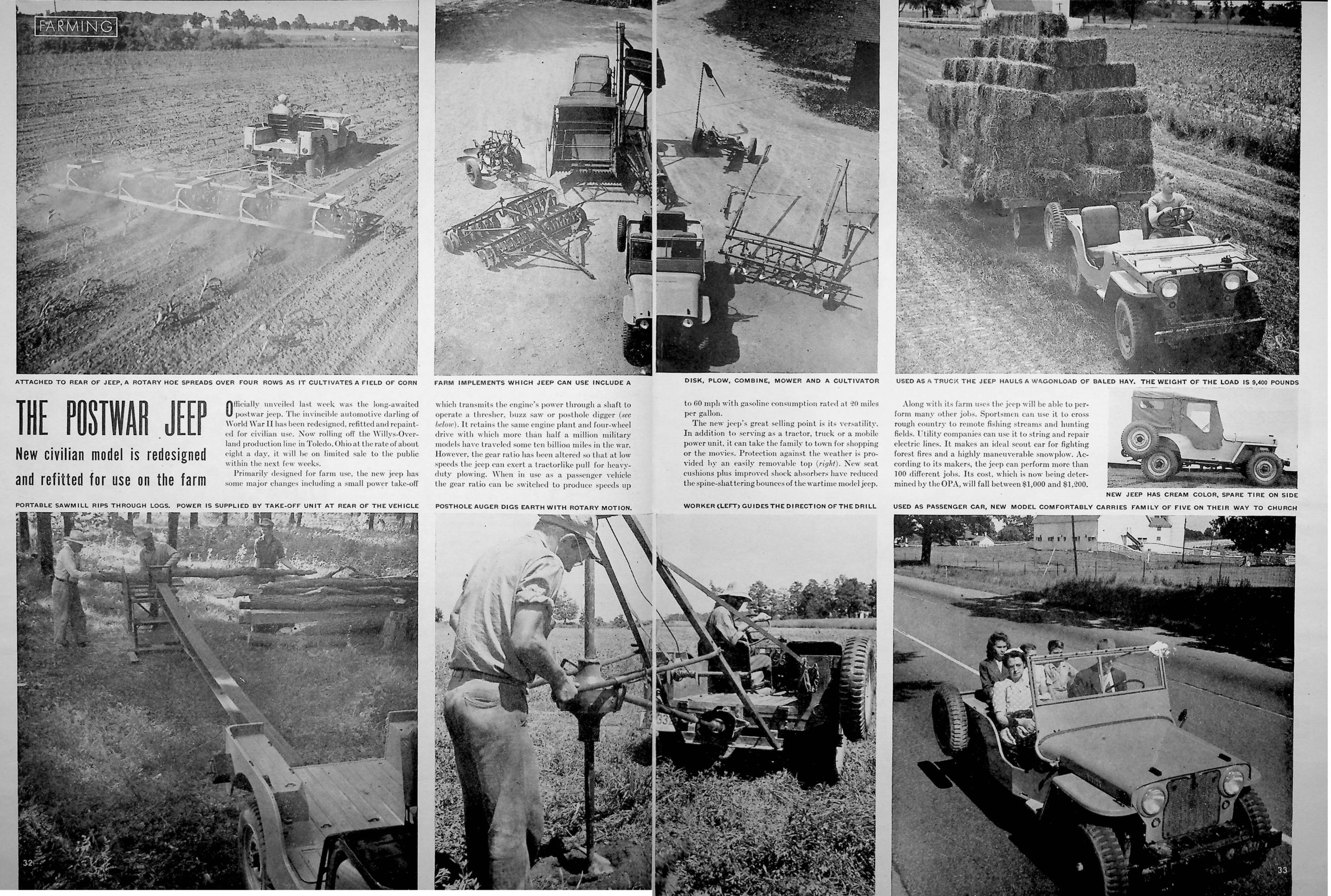
The Universal Jeep
The show continued, even after the press had left CESOR farms. A film was released and screened in theaters nationwide to continue telling the story. It is still worth watching today.
Why Jeep Day Mattered
Before 1945, automakers introduced new products the way industry had always done it—through auto shows, dealer rollouts, and months of advertising that gradually built awareness. Even the most important prewar launches unfolded over time. Willys broke that pattern. With Jeep Day, the company compressed introduction, demonstration, and national storytelling into a single, coordinated moment. In doing so, they didn’t just show a new vehicle—they told the country what it was for, and why it mattered, all at once.
Timing was everything. By launching the CJ-2A in July 1945—while the war was still being fought—Willys seized the narrative of the coming peace before anyone else had even entered the conversation. Detroit was still preparing to resume civilian production, focused on retooling factories and restarting familiar car lines. Willys stepped into that gap and defined a different future: not a return to prewar normalcy, but a transition to something new. The Jeep was positioned as a bridge between wartime ingenuity and peacetime productivity, a machine that could move seamlessly from battlefield to farm: Sword to Plowshare.
Just as important was how Willys chose to prove its case. Jeep Day was not a showroom reveal—it was a working demonstration. Plows in the ground, belts turning, implements running. Farmers, reporters, and dealers didn’t have to imagine what the Jeep might do; they could see it. That immediacy gave the vehicle credibility and clarity in a way no advertisement could. It also locked in the Jeep’s identity early. By the time competitors returned to the market, the Jeep was already understood—not as a curiosity, but as a tool.
In that sense, Jeep Day did more than launch the CJ-2A. It established the Jeep’s place in the postwar world before the postwar world had fully arrived. Detroit would go on to dominate production, but Willys had already shaped perception. And in 1945, that head start mattered.
The Race for the Lift
Sorensen and Robert Green, introduced in the last chapter, quickly turned their attention to the lift Love was developing. Even though the “Jeep Day” media had been full of praise, the Toledo Blade newspaper published a sidebar article on the day after the event titled “Farmers Wonder If Jeep Will Perform Every Job.” There were the questions of heavy plowing and crop cultivation, two issues noted in early testing. But the real issue, which I believe everyone knew, was that the Jeep, with its large turning radius, was of little use for pulling ground implements in tight spaces. However, a 3-point lift solved that problem. By lifting the implement at the end of a row, the Jeep could execute a 3-point turn to get around. Without the lift, the Jeep was no good as a tractor on a small farm with small fields – the very market Sorensen was aiming to conquer.
The Milestone: September 1946

The long wait finally ended in September 1946 — the moment the Farm Jeep truly became a tractor. At a high-profile demonstration at CESOR Farms again, Sorensen and Barney Roos were photographed personally testing the new hydraulic lift. It allowed a farmer to raise and lower a plow with a single dashboard control. For the first time, the Jeep wasn’t just pulling a load; it was operating an implement. The “Peace Jeep” was finally whole.
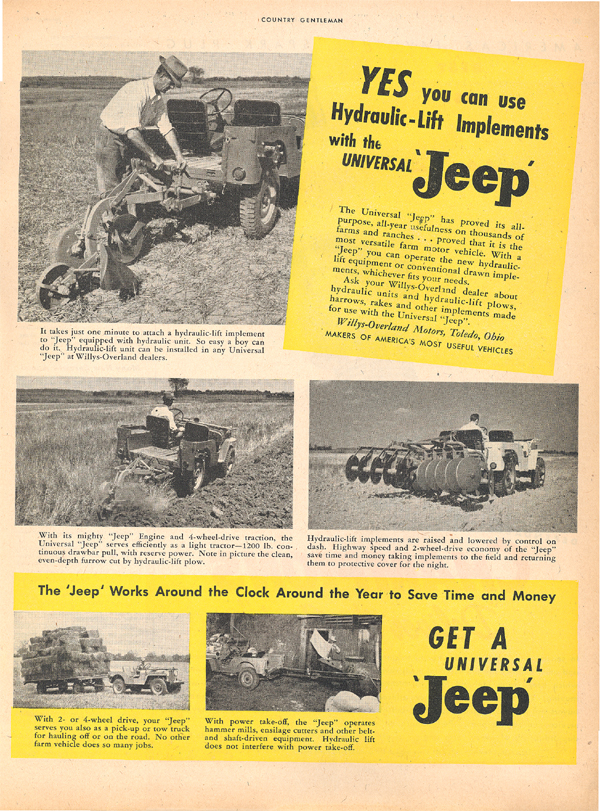
Sorensen’s Legacy
When Charles E. Sorensen stepped into the presidency at Willys in the spring of 1944, he didn’t inherit a powerhouse; he walked into a company teetering on the edge. Willys was financially fragile, operationally uneven, and lacked a clear strategic compass for the postwar era. But Sorensen didn’t just bring a resume—he brought a relentless production philosophy. As the 1946 Fortune account highlights, he immediately framed the challenge as a massive reconversion problem. His mission was simple but daunting: take a high-octane wartime production system and pivot it into a civilian product line faster than anyone else in the industry.
Sorensen’s execution was defined by a staggering sense of urgency. Under his direct influence, the civilian Jeep program was pushed with such intensity that it achieved production readiness within days of V-J Day. This was Sorensen in his purest form—an executive who prioritized speed, execution, and production above all else. He wasn’t interested in theoretical debates; he was interested in getting iron off the assembly line and into the hands of the public.
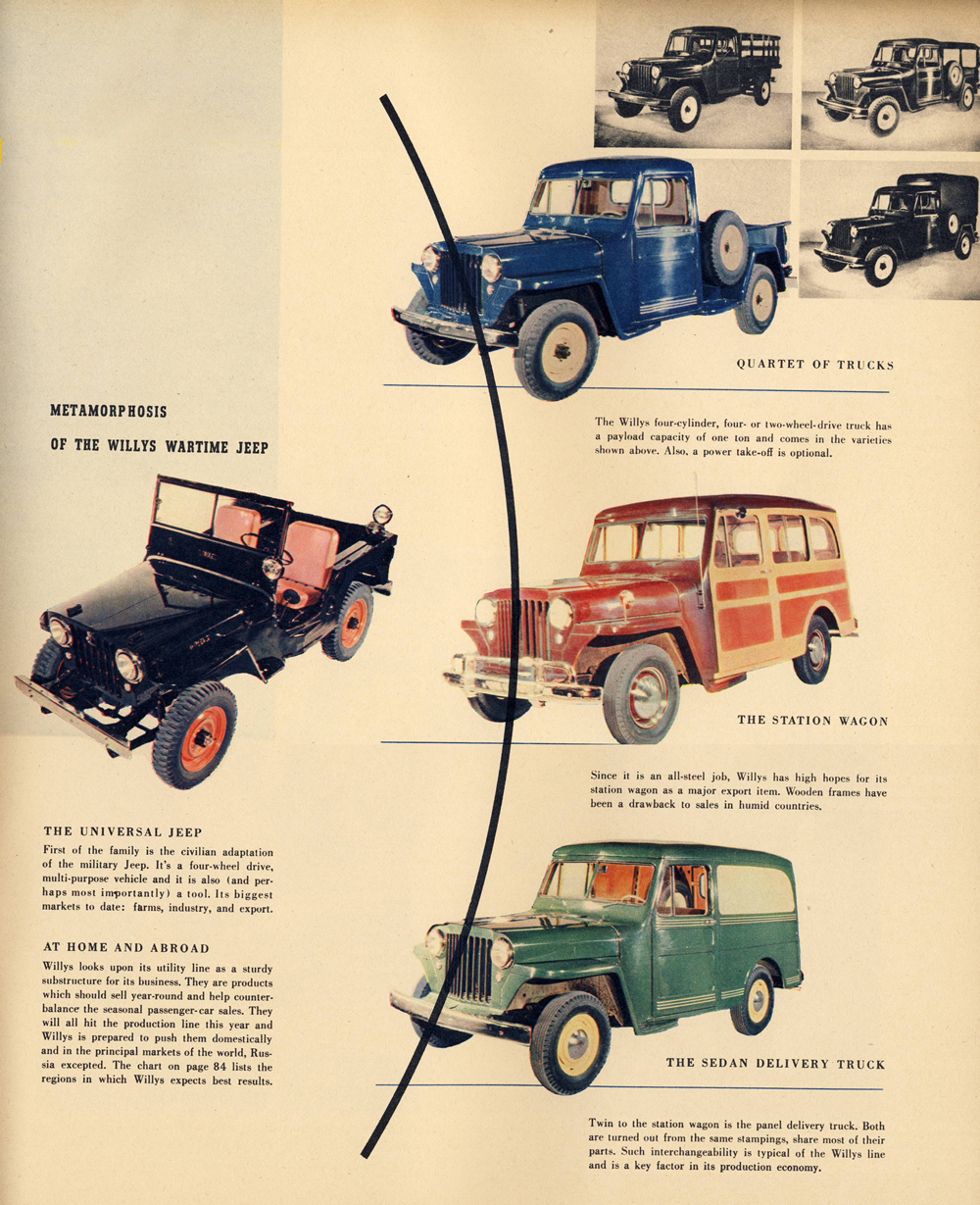
Perhaps his most vital—and frequently overlooked—contribution was the decision to effectively kill the conventional car. Almost immediately upon arrival, Sorensen scrapped plans for a standard passenger vehicle, choosing instead to redirect the company toward a dedicated “Utility Line” based on the Jeep’s DNA. This family of vehicles—comprising the Civilian Jeep (CJ), the pickup, the station wagon, and the panel delivery—represented a fundamental shift in identity. Period accounts confirm that Sorensen saw a massive opening in expanding the Jeep concept rather than trying to go toe-to-toe with the titans of Detroit.
This strategic pivot was the move that likely saved Willys from the graveyard of independent postwar automakers. Instead of trying to out-Ford Ford or out-GM GM, Sorensen repositioned Willys as something entirely distinct. He didn’t want to be a car company or a tractor company; he built a utility vehicle company. By leaning into that niche, he carved out a specialized territory that allowed Willys to survive and thrive while its peers were being swallowed by the competition.
Changing of the Guard
But even as the flashbulbs popped, the world Sorensen had built was already reorganizing itself. Jabez Love had done what he came to do. He had solved the lift problem, survived the politics, and was ready to go home to Michigan and get back to his own business. Robert Green was a different animal — quieter, more methodical, the kind of engineer who would rather refine a system than take a bow for inventing it. Sorensen had seen enough of both men to know which one he trusted with the next chapter. The Newgren Company — formed to sell the complete Farm Jeep system to American farmers — was Green’s assignment now. Whether it would work was, at this point, entirely an open question.
What We Don’t Know
Among the biggest unknowns of the Farm Jeep story is the period between July 1945 and September 1946. In those fourteen months, we do know that Love did develop his lift and that Sorensen and Green developed a close working relationship.
- What exactly happened between July 1945 and September 1946 in the engineering of the lift? Love was supposedly developing it — but who was doing what, and when did Green take over the work? The lift shown and sold after the September announcement was Love’s design. Green’s engineering changes occurred after Love had left. But Love would include many of those changes when he started making his competing version of the lift.
- What was Love’s and Green’s relationship? Love departed Willys as soon as he could to return to his business, but he would sell his implements through Green’s company, Newgren. Having studied both men, I would guess that Green would have maintained an “engineer to engineer” stance, letting Love, who was extremely independent-minded, take the lead.
- Was the September 1946 demonstration staged at CESOR Farms chosen deliberately to echo the original Jeep Day, or was the farm simply Sorensen’s go-to proving ground? Sorensen planned everything from production lines to public relations. I have no doubt it was intended to evoke the same excitement as “Jeep Day.”
- At what point did Sorensen decide to hand the commercialization to Green and Newlin (Sorensen’s former CESOR farms manager), and what exactly was Newgren’s legal relationship to Willys? The Newgren company, as we will show in the next chapter, was intended to be a totally separate company. Of more interest and one of the great unsolved questions is why Sorensen chose Green to partner with Newlin? We will explore this question further in the next chapter.
What we do know is that in the summer of 1946, Sorensen was ready to stage another event that would make the Jeep behave like a tractor so it could challenge the 9N.
To Sum Up This Chapter
The summer and fall of 1945–1946 represent the Farm Jeep’s finest hour. Sorensen’s audacious “Jeep Day” launch exploited a wartime loophole to beat every competitor to market. The CJ-2a was introduced to America as a farm machine before the war was even over. A year later, the addition of the Love-designed hydraulic lift completed the vision — the Jeep could finally work the land. Yet even at its moment of triumph, the seeds of future trouble were planted: Love was leaving, Green was inheriting, and nobody yet knew whether the Newgren Company could turn a wartime engineering project into a business.