
Chapter 1 of 8
The World the Farm Jeep Was Born Into
The Farm, the Tractor, and the Sword (1900–1944)
“The horse is too expensive to keep… It is a question of power, and we must find a way to apply the power of the gasoline engine to the work of the farm.”
— Henry Ford
The Farm Jeep story didn’t begin on a drawing board in 1945. It began in the muddy fields of the early 1900s — and in the motor pools of a country preparing for war. Both stories, the farm and the battlefield, were running in parallel for decades before they finally collided in a Toledo factory at the end of World War II. You need to understand something of both to understand what happened next.
This chapter is a prologue. It is the world the Farm Jeep was born into.
Part One: The Farm and the Tractor (1900–1939)
🔭 The 10,000-Foot View
In the early 20th century, the American farm was on the edge of a mechanical revolution. For centuries, muscle power — human and animal — had set the pace of everything that happened between planting and harvest. What changed was not a single invention but a collision of visionaries, competing corporate ambitions, and a mass-production genius named Charles Sorensen. Their work gave American farmers the affordable, lightweight tractor — and in doing so, unknowingly created the market the Farm Jeep would later try to capture.
Before the Farm Jeep could exist, three companies and a small group of individuals needed to lay the foundation: Ford and Sorensen pioneering mass-produced mechanical farming, Willys-Overland building the engine that would power the whole story, Monroe Auto Equipment quietly securing the financial ties that would bind them all together, and an independent Michigan engineer named Jabez Love, who was already dreaming of a machine that could work the field and drive to market on the same day.
The Visionaries: Ford and Sorensen
The development of the Fordson tractor was driven by Henry Ford’s obsession with “Automating the horse” and the ruthless production efficiency of his right-hand man, Charles Sorensen. While Ford had experimented with tractor prototypes as early as 1907, it was Sorensen who played the critical role in transitioning from heavy, cumbersome designs to the lightweight, mass-producible Model F. By 1916, Sorensen had helped refine a revolutionary “unit-frame” construction where the engine, transmission, and differential housings were bolted together to form the actual chassis of the tractor — eliminating the need for a heavy separate frame, significantly reducing weight and cost. Despite opposition from Ford Motor Company shareholders, Henry formed a separate entity, Henry Ford & Son, to bring the vision to life in 1917.
Under Sorensen’s direction, the Fordson became the first tractor built on a moving assembly line, mirroring the success of the Model T. This manufacturing prowess allowed the Fordson to be sold for $750 — a price that decimated the competition and made mechanized farming accessible to the average American family. Sorensen’s influence extended to the tractor’s global reach; during World War I, he oversaw a massive order of 6,000 units for the British government to combat food shortages, which solidified the Fordson’s dominance. By the early 1920s, Fordson controlled roughly 75% of the U.S. tractor market, effectively doing for the field what the Model T had done for the road.
Remember Sorensen’s name. We’ll be seeing a lot more of him.

Willys-Overland
The story of Willys-Overland is a classic American tale of industrial ambition, near-collapse, and ultimate redemption. Founded by John North Willys in 1908, the firm quickly skyrocketed to prominence — by 1912 it was the second-largest automaker in the United States, trailing only Ford. In 1919, Willys led a group of investors to purchase the Moline Plow Company for approximately $28 million, producing the innovative Moline Universal Tractor. While technologically ambitious, the venture was short-lived; the agricultural depression of the early 1920s and stiff competition from Ford’s Fordson forced the company to cease tractor production by 1923.
The road through the 1920s and 30s was notoriously bumpy. After aggressive expansion and personal financial maneuvering by John Willys, the company slid into receivership in 1933. It was saved by the leadership of Ward Canaday and the engineering brilliance of Barney Roos, who streamlined the lineup to focus on the economical, four-cylinder Willys 77. This pivot toward lightweight, high-torque engines proved prophetic — as the clouds of World War II gathered, Willys-Overland’s refined “Go-Devil” engine became the heart of the prototype that would win the government contract for a “light reconnaissance vehicle.”
Note the pattern. Willys-Overland had already tried the farm market in 1919 — and failed. The agricultural depression had killed that first attempt. By 1933, the company itself nearly died. What saved it was a lean, high-torque engine and a willingness to pivot. Those same qualities would define its second attempt at the farm market, a decade later.
Monroe Auto Equipment Company
The Monroe Auto Equipment Company (MAECO) originated in 1916 in Monroe, Michigan. In 1926, they introduced the “Shock Eliminator,” the company’s first shock absorber, setting the stage for their dominance in ride control. During the pre-war period, Monroe solidified a critical relationship as a supplier to Willys-Overland, located just 15 miles away in Toledo.
Following the post-WWI economic recession, Willys-Overland found itself drowning in debt. The McIntyre family, which owned Monroe Auto Equipment, held significant claims as a key supplier. Rather than forcing a liquidation that might have shuttered the Toledo plant, Monroe and other major creditors agreed to a debt-extension plan — a strategic gamble that kept Willys solvent and ensured the survival of Monroe’s largest customer. This early history of mutual survival explains the seamless transition into their post-war partnership that became a pivotal part of the Farm Jeep story.
That partnership will eventually turn toxic. But in 1920, Monroe saved Willys. Keep that in mind when we get to what Monroe did to the Farm Jeep program later.
Jabez Love: The Connector
Jabez Arthur Love, born in 1909, spent the late 1920s and early 1930s establishing himself as a formidable engineer in Benton Harbor, Michigan. Witnessing the inefficiencies of fruit farmers who had to double-handle their produce between orchard and market, Love envisioned a high-speed solution. In 1933, at just 23 years old, he began manufacturing his first tractors — “Tructors” — capable of reaching 40 to 60 mph on the road, allowing farmers to haul harvests directly from field to the Benton Harbor Fruit Market.
The mid-to-late 1930s saw Love’s innovations evolve as he transitioned to more standardized production models. Recognizing that the Ford 9N introduced in 1939 represented “the future of farming,” Love became a Ford tractor dealer. When he discovered farmers were hesitant to buy the light Ford tractors without a disc harrow — which Ford did not yet offer for the three-point hitch — Love engineered his own three-point mounted disc. This move positioned him as a pioneer in the implement industry, setting the stage for his wartime role as a consultant for Willys-Overland and his development of the first hydraulic lift for the civilian Jeep.
Jabez Love was, in miniature, exactly what the Farm Jeep was trying to be: a single machine that could do the work of several. The Jeep didn’t find its hydraulic heart by accident. It found it through Love.
The Machine That Changed It All
The introduction of the Ford 9N tractor in 1939 marked a turning point in American agriculture by making mechanized farming more accessible to small and mid-sized family farms. Developed through the collaboration of Henry Ford and Harry Ferguson (with Charles Sorensen also involved), the 9N was the first mass-produced American tractor to integrate the Ferguson three-point hitch and hydraulic lift system as standard features. This innovation fundamentally changed how implements interacted with tractors, improving traction, safety, and efficiency by allowing mounted tools to rise and fall with the tractor rather than being pulled independently. As a result, a single operator could perform tasks that previously required multiple animals or workers, significantly increasing on-farm productivity at a time when agriculture was under pressure from the Great Depression and, soon after, wartime food demands.
Beyond its technical advances, the Ford 9N had a lasting economic and cultural impact on farming. Designed to be affordable and easy to maintain, it lowered the barrier to entry for tractor ownership and accelerated the shift away from horse-powered agriculture in the United States. Its success established a design template that influenced nearly all subsequent tractor development, with the three-point hitch becoming an industry standard still used worldwide today. The popularity of the 9N also set the stage for the highly successful Ford N-series tractors that followed, reinforcing Ford’s role in shaping 20th-century agricultural mechanization and permanently altering how food was produced on American farms.
The Ford 9N would be the standard for the Farm Jeep as a tractor. The bar had been set.
The Farm Before WWII (1940)
The 1940 Census of Agriculture shows that animal power was still dominant on American farms:
- 53% of farms used horses and/or mules and had no tractor
- 18.6% of farms reported owning at least one tractor
- About 4–5% of farms had both tractors and horses, indicating a transitional stage
- Roughly 24% of farms reported neither horses nor tractors (mostly very small or specialty farms)
Horse-to-tractor ratio (farms reporting power):
➡️ About 3 farms rely on horses for every 1 farm with a tractor
This confirms that, on the eve of WWII, tractors were still the minority power source nationwide, with horses and mules remaining essential, especially on small and Southern farms. This was the farm world the designers of the Farm Jeep would be facing.
The Tractor Wars book and Iowa PBS documentaries of the same title are a perfect introduction to the history and technology of farming that led to the Farm Jeep. While the title speaks of tractor wars, it is a history of farming in America — and a history of the market the Jeep was about to enter. They are both listed in the Dig Deeper section.
To Sum Up Part 1
By 1939, the American farm had been remade — but only halfway. The gasoline engine had proven it could replace the horse. Ford and Sorensen had proven it could be built cheaply enough for ordinary farmers to own. And the 1940 census made the opportunity plain: three farms still relied on animal power for every one that owned a tractor. That was an enormous market no one had fully captured yet.
Part Two: The Sword (1935–1944)
“The Jeep is a versatile fellow… and after the war is over, he’s going to have a big job to do on the farm.”
— Popular Science, 1943
🔭 The 10,000-Foot View
Between 1935 and 1942, the jeep transformed from a strict military design requirement into a cultural icon. Even as the war had just begun, farmers and soldiers alike were looking past the conflict toward a future in which this rugged vehicle would become the ultimate multipurpose tool for peace. Meanwhile, the farms where the jeep would one day find a home were changing forever — for reasons that had nothing to do with the military.
The sword was being forged. And almost from the moment it appeared, people were already asking whether it could become a plowshare.
When the Army Needed to Replace the Mule
The story of the development of the military vehicle that became known as the “jeep” has been told many times. Some of these are listed in the “Dig Deeper” page. In this section, we will look at the key companies that forged the sword: American Bantam Car Company, Ford Motor Company, and Willys-Overland. Even as the jeep was being designed and built, some were already thinking ahead to a “Peace Jeep.”
Between the two World Wars, the United States Army faced a daunting logistical crisis: the “motorization” of an infantry and cavalry still largely dependent on the mule. While trucks could move heavy loads on improved roads, the Army lacked a small, agile vehicle capable of traversing broken terrain, hauling machine guns, and performing reconnaissance. Initial attempts to replace the pack animal involved stripping down civilian Ford Model Ts or experimenting with “motorcycles with sidecars,” but these lacked the traction and durability required for combat. The military’s search was driven by the realization that modern warfare would move at a pace the four-legged mule simply could not match, leading to a series of experimental “scout cars” and “light personnel carriers” throughout the 1930s.
The true breakthrough began with a series of high-clearance, lightweight experiments often referred to as “belly floppers” or “midget cars.” Most notable was the Howie Belly Flopper, a low-profile machine that required the crew to lie prone to reduce the target size. While these early prototypes were ultimately impractical for general use, they proved that a small, four-wheel-drive vehicle could theoretically navigate the same narrow trails as a pack mule. By 1940, the Infantry and Cavalry finally consolidated their requirements into a single tender for a “1/4-ton 4×4 Command Reconnaissance Truck.” This specific request — after decades of failed experiments to mechanize the mule’s versatility — directly led to the American Bantam prototype that would eventually become the jeep.
American Bantam Car Company
Born from the ashes of the American Austin Car Company, the American Bantam Car Company of Butler, Pennsylvania, was a scrappy underdog that played a disproportionately large role in automotive history. Reorganized in 1936 by Roy Evans, the company specialized in “bantam-weight” vehicles — tiny, fuel-efficient cars that were often styled like high-end luxury automobiles that had been shrunk in the wash. Despite their charming aesthetic and impressive 60 miles per gallon efficiency, these miniature machines struggled to find a foothold in a Depression-era market that still favored full-sized power. By 1940, the company was teetering on the edge of bankruptcy, its assembly lines slowing as the American public remained skeptical of the “midget car” concept.
However, Bantam’s legacy was secured not by its civilian roadsters, but by a desperate, last-minute bid to save the company through military innovation. When the U.S. Army issued an “impossible” request in 1940 for a lightweight, four-wheel-drive reconnaissance vehicle, Bantam was the only manufacturer to deliver a working prototype within the grueling forty-nine-day deadline. This vehicle, the Bantam Reconnaissance Car (BRC), became the DNA for what the world would eventually know as the jeep. Though Bantam’s limited production capacity led the government to hand the massive wartime contracts to Willys-Overland and Ford, the small team in Butler remains the true architect of the vehicle that General George Marshall called “America’s greatest contribution to modern warfare.”
Bantam is often viewed as the loser in the jeep story. All the glory has gone to Willys and Ford. The reality is that Bantam possessed an incredible engineering department and terrible corporate management. Although Bantam quickly disappeared from the military jeep scene (they are remembered more for the trailers the jeep towed), they will return in later chapters to have a major impact on the Farm Jeep. And not in a good way.

Willys-Overland and the Go-Devil Engine
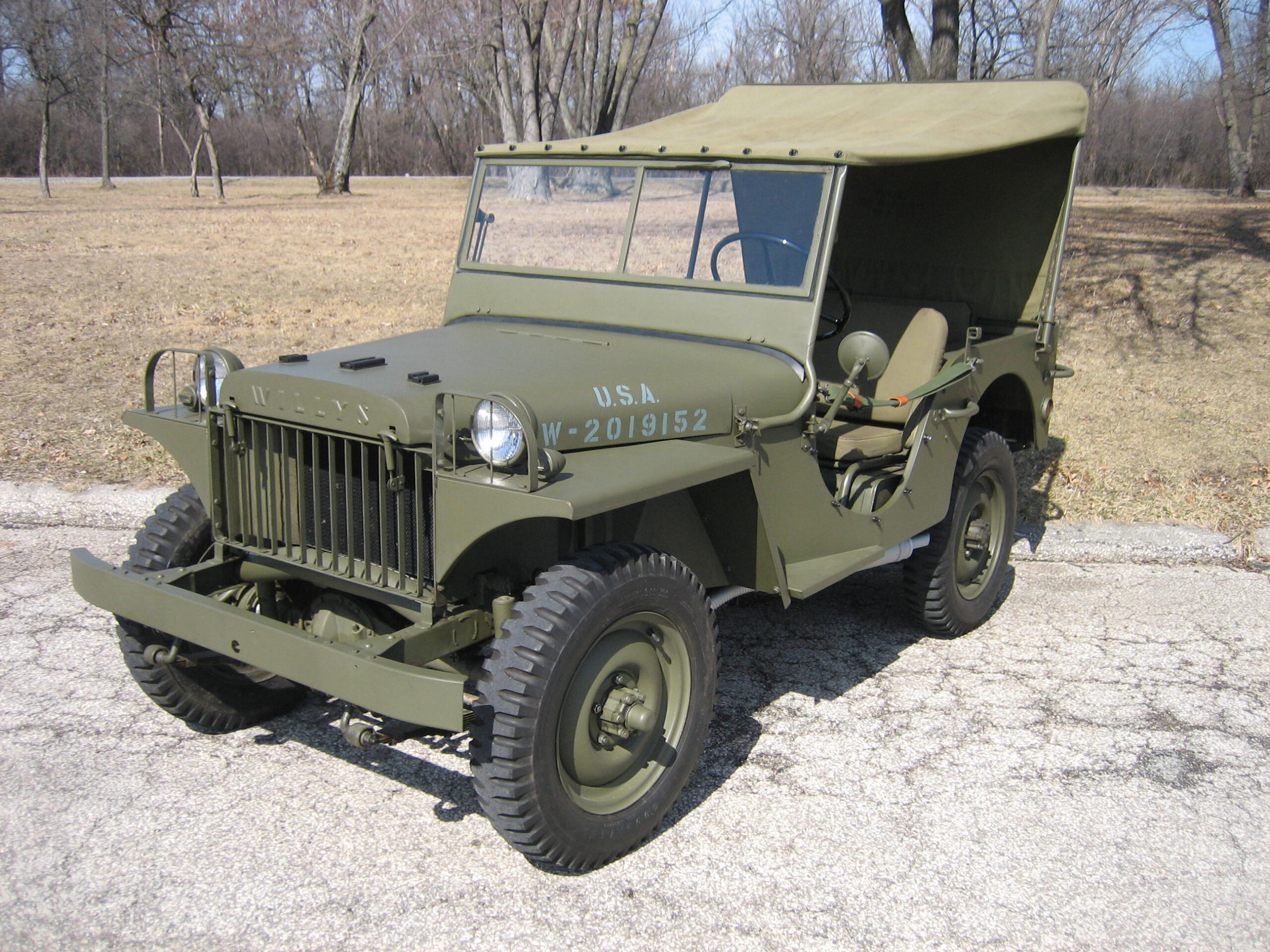
Willys and Ford were invited to develop their own prototypes — the Willys “Quad” and the Ford “Pygmy” — using Bantam’s blueprints as a guide. Willys eventually won the primary production contract because their model, the Willys MA (later refined into the standardized MB), offered the most power and durability of the three competitors.
The engineering brilliance behind Willys’ success was Delmar “Barney” Roos, the company’s Vice President of Engineering. Roos recognized that the Army’s requirements for torque and speed could not be met by the anemic 48-horsepower engines used in existing small cars. He took a 1926-era four-cylinder engine and completely re-engineered it into the legendary “Go-Devil” L134 engine. By adding a counterbalanced crankshaft, aluminum pistons, and a superior lubrication system, he increased the output to 60 horsepower. This engine became the “heart” of the jeep, outperforming the Continental engine used by Bantam and the tractor-derived engine used by Ford.
Beyond the engine, Roos was instrumental in overcoming a critical design hurdle: weight. The original Willys prototype, the Quad, was significantly over the Army’s strict 2,160-pound weight limit. Rather than sacrificing the heavy, powerful Go-Devil engine, Roos and his team embarked on a “shave and save” campaign, redesigning every component of the vehicle to shed ounces. They trimmed bolt lengths, reduced the body steel thickness, and even switched to a single coat of paint. These efforts allowed Willys to maintain its superior performance while meeting military specifications, resulting in the production of over 360,000 Willys MBs during World War II.
Ford Motor Company
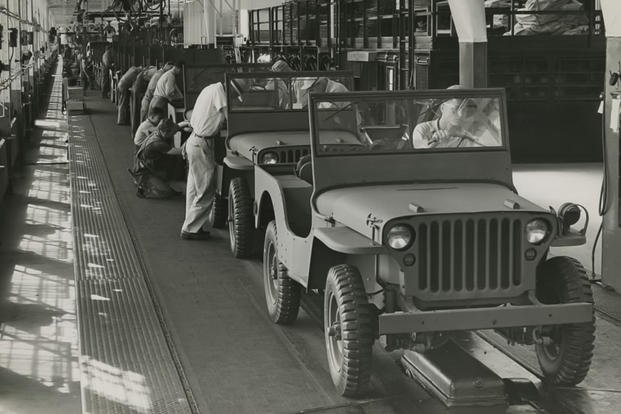
While Ford eventually became the powerhouse that produced over 280,000 Jeeps during World War II, the company’s entry into the “war fight” was initially stalled by Henry Ford’s personal convictions. A staunch pacifist who had famously chartered a “Peace Ship” during World War I, Henry Ford remained deeply skeptical of American involvement in another European conflict. His reluctance was so profound that in 1940, he notoriously refused a contract to build 6,000 Rolls-Royce Merlin aircraft engines for the British RAF, declaring that Ford Motor Company would build only for “defense” and not for foreign belligerents. This stance created a significant bottleneck for the U.S. military, which desperately needed Ford’s unrivaled mass-production capabilities.
The shift in Ford’s trajectory was largely orchestrated by Charles “Cast-Iron Charlie” Sorensen, Ford’s formidable production chief. Sorensen, a pragmatic realist, recognized that the global tide was turning and that Ford’s survival — and the nation’s security — depended on industrial mobilization. Throughout 1940 and 1941, Sorensen worked behind the scenes to nudge Henry Ford toward military cooperation. Sorensen’s influence was the catalyst that finally moved the company from “isolationist observer” to the “Arsenal of Democracy,” leading to the construction of the massive Willow Run bomber plant and the adaptation of Ford’s Rouge plant for Jeep production.
Once the company committed, Ford’s engineering contributions to the jeep were transformative. While the Willys-Overland “Go-Devil” engine was superior, Ford’s “Pygmy” prototype introduced several design features that the Army mandated for the final standardized jeep (the MB/GPW). Most notably, Ford’s flat-topped hood and stamped-steel grille with integrated headlights became the vehicle’s iconic face. These design choices weren’t just aesthetic; they were calculated by Sorensen and his engineers to simplify mass production. Ford’s ability to manufacture parts with extreme precision allowed for total interchangeability with Willys’ components — a logistical miracle that ensured a soldier in the field could take a part from a Ford-built jeep (the GPW) and bolt it directly onto a Willys-built model (the MB).
And here is where Sorensen’s name should ring a bell again. This is the same man who built the Fordson. The same man who mass-produced tractors at $750 each. In 1944, he’s about to walk into Willys-Overland — and his next project will be figuring out what to do with a factory producing jeeps when the Army stops ordering them.
The “Peace Jeep” Concept
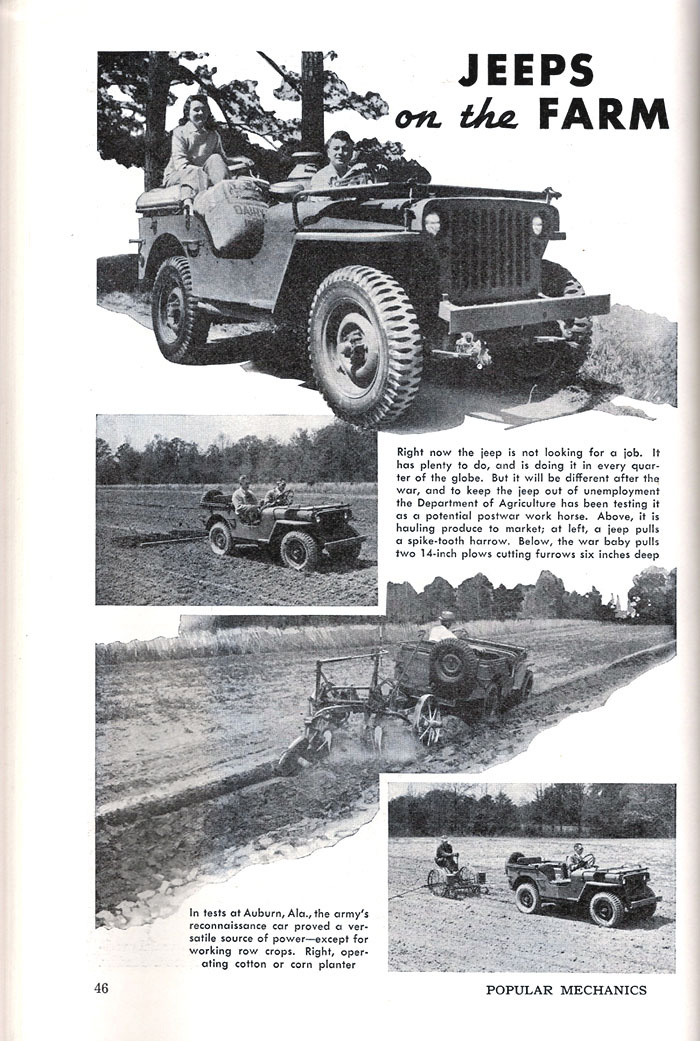
During 1942 and 1943, even as the military jeep was proving its worth on the battlefield, the U.S. Department of Agriculture (USDA) and various state colleges began rigorous testing to determine whether the vehicle could replace horses and mules on American farms after the war. These tests had come at the request of the State Department, which, even in the earliest days of the war, was looking ahead to having to “feed a devastated Europe.”
On May 27, 1942, the USDA issued a press release titled “First of Post-War Salvage Tests Shows Jeep Could Be Used on Farm.” The Department, in collaboration with the “Country Gentleman,” obtained two jeeps from the War Department and conducted an exploratory test at the USDA’s Tillage Machinery Laboratory in Auburn, Alabama, during the period April 10–18, 1942. An article describing these tests was prepared by and published in the “Country Gentleman” for June 1942, under the title “Some Day There Will Be Harnesses on the Jeep.”
The results of these 1942–1943 trials were a mix of optimism and practical criticism. While the jeep was praised for its agility and multi-purpose potential — acting as a truck, tractor, and power plant all in one — testers noted significant drawbacks for heavy agricultural work. It was found to be somewhat underpowered for heavy plowing and lacked the necessary “crop clearance” for cultivation, as it was too low to pass over growing crops without damaging them. Furthermore, its narrow track width did not always align with standard row-crop spacing.
Despite these limitations, the data gathered during this period was invaluable to Willys-Overland engineers like Barney Roos. The 1943 reports, including an influential 20-page monograph from Washington State University titled “The Jeep as a Farm Truck-Tractor,” provided the blueprint for the first civilian models. These insights led directly to the development of the “AgriJeep” prototypes and, eventually, the standardized CJ-2A.
Note what the critics were saying. The jeep was underpowered for heavy plowing. It lacked crop clearance. Its track width was wrong for row crops. None of those criticisms said it was useless. They said it wasn’t a large commercial farm tractor — which it was never designed to be. What the tests confirmed is that it worked. It just worked for a specific kind of farmer, on a specific kind of farm. Finding that farmer and convincing him to buy would be Willys-Overland’s challenge for the next decade.
To Sum Up This Chapter
The world the Farm Jeep was born into was shaped by two parallel stories. In the fields, Ford and Sorensen had demonstrated that the gasoline engine could replace the horse — if the machine was cheap enough, light enough, and simple enough for ordinary farmers to own. Jabez Love had proven that a single vehicle could work the field and drive the market road. Monroe had proven that corporate survival sometimes depends on keeping your neighbors alive. And Willys-Overland had already failed once in the farm market, survived bankruptcy, and rebuilt itself around a lean, high-torque engine.
In the motor pools and proving grounds, the Army’s desperate search for a mechanical mule had produced something remarkable: a small, fast, four-wheel-drive vehicle that could go almost anywhere. By 1942, even before the war was won, the USDA was already testing whether that vehicle could come home to the farm. The tests were promising. The limitations were real. And the man who would figure out what to do next — Charles Sorensen — had built both the Fordson tractor, the 9N, and the Willow Run arsenal. He knew a thing or two about turning a military machine into something a farmer could use.
The sword was ready. The farm was waiting. The real story starts in the next chapter.